The Role of Molecular Sieve Powder in the Adhesives & Sealants Industry
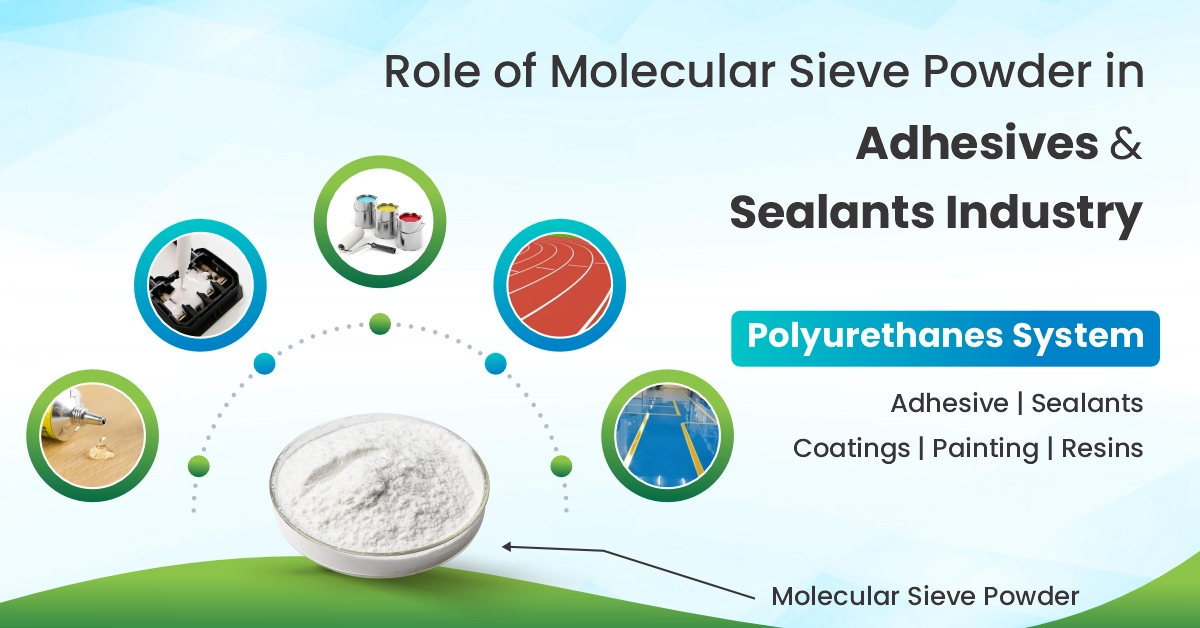
Moisture is the silent enemy of adhesives and sealants. It sneaks in during manufacturing, storage, or application and by the time you notice the damage, it's already too late. Bubbles have formed. The bond has weakened. The sealant has started curing inside the tube before it even reaches the job site. These are not rare problems. They happen every day across industries that rely on high-performance bonding solutions.
This is exactly where molecular sieve powder steps in.
What Is Molecular Sieve Powder?
Before getting into its role in adhesives and sealants, it helps to understand what this material actually is. Molecular sieve powder is a form of zeolite powder for adhesives and industrial applications - a crystalline, porous material with a very specific and uniform pore structure. These tiny pores are engineered to trap moisture molecules while leaving everything else untouched.
Think of it like a microscopic sponge that only absorbs water and holds it permanently, even under pressure or heat. That selective absorption is what makes it so valuable in formulations where moisture control is critical.
Why Moisture Is Such a Big Problem in Adhesives and Sealants
Water molecules are small, fast-moving, and surprisingly difficult to keep out of a formulation. Even trace amounts of moisture can trigger unwanted chemical reactions in moisture-curable systems like polyurethane (PU) adhesives and silicone sealants.
Here's what typically goes wrong:
Bubbles in adhesives are one of the most common complaints in PU-based formulations. When moisture reacts with isocyanate groups in the adhesive, it releases carbon dioxide gas. That gas has nowhere to go so it forms bubbles inside the bond line. The result is a weak, porous joint that looks fine on the surface but fails under stress.
Premature curing in the container is another major headache. If moisture enters the packaging during storage or filling, the sealant begins to cure before it's applied. By the time it reaches the customer, it's already partly gelled unusable and wasteful.
Adhesive moisture problems also affect viscosity, open time, and final strength. A formulation that performs perfectly in a dry lab environment can behave completely differently on a humid job site or in a tropical climate. This unpredictability makes quality control much harder.
The answer to all of these problems lies in better moisture control in adhesives and sealants and molecular sieve powder for adhesives is one of the most effective tools available.
How Molecular Sieve Powder Works in Adhesive Formulations
When molecular sieve powder for adhesives is blended into a formulation, it acts as an internal guard against moisture. Any water present in the raw materials, or any that enters during mixing and filling, gets immediately captured by the sieve particles before it can cause damage.
This is not a surface treatment or a coating. The powder is distributed throughout the adhesive matrix itself, giving protection from within. It is inert meaning it does not react with the adhesive chemistry, does not affect colour significantly, and does not compromise the final bond strength. In fact, it protects it.
For moisture-curable polyurethane adhesives, this is especially critical. The entire curing mechanism depends on moisture from the air. But that moisture should come from outside the bond, after application not from inside the can before it's opened. Molecular sieve powder ensures that the formulation stays reactive and ready, right up until the moment it's needed.
The Role of Molecular Sieve Powder in Sealants
Sealants face many of the same challenges as adhesives, but with some additional complications. They are often stored for longer periods, exposed to more variable conditions, and expected to perform in demanding environments gaps in construction joints, automotive assemblies, glazing systems, and more.
Using molecular sieve powder for sealants addresses several issues at once.
First, it works as a moisture scavenger for adhesives and sealants during the manufacturing stage. Raw materials like polyols, fillers, and pigments often carry residual moisture. Without something to capture that moisture early in the process, it can react with isocyanates or other reactive components during mixing reducing pot life and causing inconsistencies in the final product.
Second, desiccant powder for sealants helps protect the product during its shelf life. Packaging is never perfectly sealed. Over months of storage, small amounts of moisture can migrate through cartridge walls or past seals. A well-formulated sealant with an internal moisture scavenger handles this far better than one without.
This directly leads to sealant shelf life improvement one of the most commercially important benefits of incorporating molecular sieve powder. A sealant that remains stable and fully reactive for 12 to 18 months is far more valuable than one that starts to degrade after six. Distributors and end users both benefit from the extended usability window.
Zeolite Powder for Adhesives Getting the Grade Right
Not all molecular sieves are the same. The pore size determines what gets absorbed. The most commonly used grades in adhesive and sealant applications are 3A and 4A zeolite powder.
3A molecular sieve has pores of around 3 angstroms large enough to absorb water molecules but small enough to exclude most organic solvents and reactive components in the formulation. This makes it the preferred choice for reactive systems where you want moisture scavenging without interference.
4A molecular sieve has slightly larger pores and is used in applications where a broader absorption profile is acceptable.
The powder form is specifically chosen for adhesive and sealant applications because it disperses evenly through the formulation, provides maximum surface area for absorption, and does not settle out or cause grittiness in the final product when the correct particle size is used.
Moisture Control in Adhesives and Sealants Practical Benefits
When you bring all of this together, the practical advantages of using molecular sieve powder in formulations are clear:
- Eliminates bubble formation in polyurethane and reactive adhesives
- Prevents premature curing inside the packaging
- Extends shelf life of both adhesives and sealants
- Improves batch-to-batch consistency during production
- Reduces waste and customer complaints related to moisture-related failures
- Supports humidity-resistant formulations for tropical and coastal markets
For formulators, adding the right grade of molecular sieve powder is one of the simplest and most cost-effective interventions available. The loading levels are typically low often between 1% and 5% by weight which means the impact on raw material costs is minimal compared to the quality improvement it delivers.
Final Thoughts
Moisture will always find a way in. The best formulations don't try to keep it out entirely - they manage it intelligently from within. Molecular sieve powder gives adhesive and sealant manufacturers a reliable, proven way to do exactly that.
Whether you're dealing with bubbles in adhesives, struggling with moisture control in sealants, or simply looking for sealant shelf life improvement without reformulating from scratch, the answer is often already available in a fine white powder sitting quietly in a sealed drum ready to do its job.
