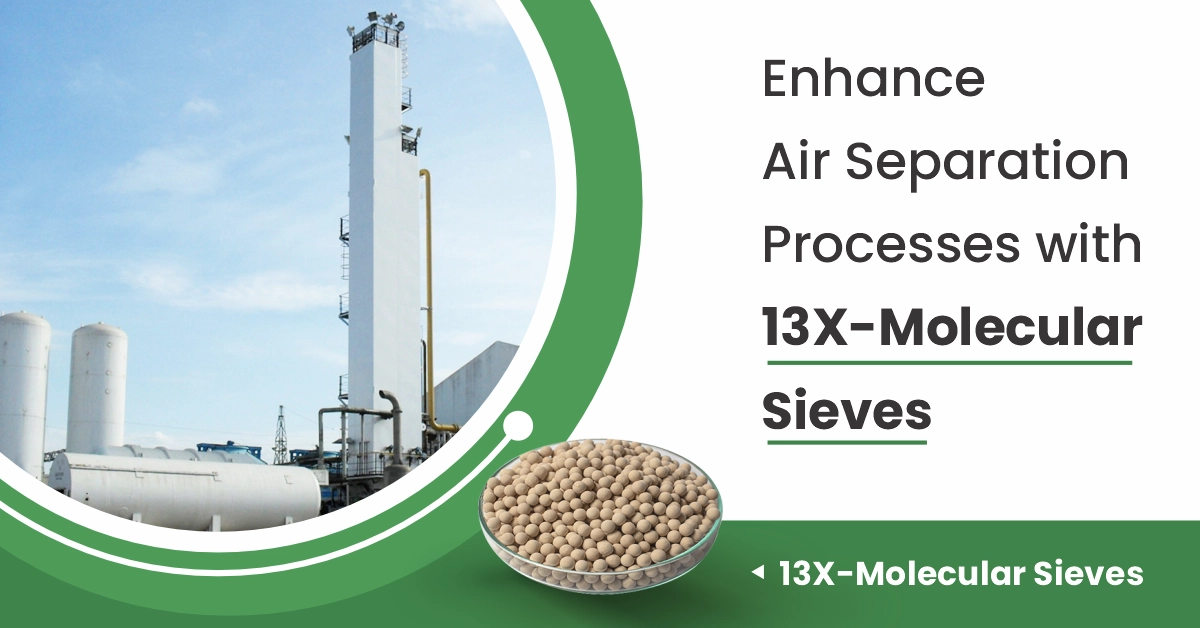
Air separation processes are critical across numerous industries, from manufacturing to energy production. These processes require the removal of moisture, carbon dioxide, and other impurities to produce high-purity gases. 13X molecular sieves have emerged as an essential solution for air purification and separation applications, offering superior adsorption properties and reliability in demanding industrial conditions.
Understanding 13X Molecular Sieves
13X molecular sieves are a type of adsorbent material made from zeolite crystals. The type X crystalline foam known as molecular sieve type 13X is sodium-based and has a pore diameter of 10 Angstroms (10Å). Zeolites are porous materials that can trap and hold molecules, making them highly effective for various separation and purification processes.
Key Characteristics:
- Large Pore Size: With a pore diameter of approximately 10Å, Zeolite 13X molecular sieves have a wider pore diameter compared to 3A, 4A, and 5A sieves
- High Adsorption Capacity: This allows them to adsorb larger molecules including water, carbon dioxide, hydrocarbons, oxygen, and nitrogen
- Selective Adsorption: The material has selective adsorption qualities, meaning molecular sieves 13X can specifically target and remove certain contaminants
- Multiple Forms: Available in both beads and pellets shapes for various applications
- Size Range: Available in different sizes ranging from 1.5-1.7 mm, 3.0-3.3 mm in pellets and 1.6-2.6mm, 2-4 mm as well as 3.0-5.0 mm in beads
- High Mechanical Strength: With crushing strength of more than 36 N, it can withstand high inlet pressure
Air separation is one of the most critical processes in modern industry. From producing oxygen for healthcare and steelmaking, to nitrogen for electronics and food packaging, the purity of gases directly impacts efficiency, safety, and product quality. Achieving this purity requires advanced adsorbent materials capable of removing moisture, carbon dioxide, and other contaminants. Among the most effective solutions are 13X molecular sieves, a sodium based zeolite with a pore size of approximately 10 Å. Their unique structure and adsorption properties make them indispensable in air separation units (ASUs), cryogenic systems, and gas purification applications.
Role in Air Separation Units (ASUs)
Air separation units are designed to produce oxygen, nitrogen, and argon by liquefying and distilling atmospheric air. Before liquefaction, contaminants such as CO2 and H2O must be removed to prevent blockages and equipment damage.
- Moisture Removal: 13X zeolite sieves efficiently adsorb water vapor, ensuring dry air streams.
- CO2 Adsorption: Prevents solid CO2 formation at cryogenic temperatures, protecting heat exchangers.
- Hydrocarbon Control: Adsorbs trace hydrocarbons that could otherwise freeze and obstruct pipelines.
Applications in Cryogenic Systems
Cryogenic air separation operates at extremely low temperatures, where even trace impurities can cause severe damage. molecular sieves 13X are widely used in these systems because of their ability to function effectively under cold conditions.
- Mercury Removal: Prevents corrosion of aluminium components in cryogenic heat exchangers.
- Hydrocarbon Adsorption: Traps heavier hydrocarbons that could condense and block passages.
- Reliability: Their reusability and regeneration capability make them cost effective for long term cryogenic operations.
Cryogenic plants rely on 13X sieves not only for purification but also for safeguarding capital intensive equipment.
Natural Gas Drying and Sweetening
Natural gas often contains water, CO2, and sulphur compounds that must be removed before distribution. 13X molecular sieves are highly effective in this domain:
- Deep Drying: Can reduce water content to as low as 0.1 ppm, ensuring pipeline safety.
- CO2 Removal: Prevents corrosion and freezing in low temperature processes.
- Sulphur Compound Adsorption: Used in sweetening processes to eliminate mercaptans and hydrogen sulphide.
Their efficiency at low concentrations makes zeolite 13X sieves superior to conventional drying methods, especially in low temperature natural gas processing.
LPG Purification and Aerosol Industry
- Process: LPG is passed through beds of 13X sieves, which adsorb mercaptans into their pore structure.
- Outcome: Odor free LPG suitable for aerosol sprays and consumer products.
- Non Regenerable in This Case: Once saturated with mercaptans, the sieve cannot be regenerated, but for other contaminants, regeneration is possible.
In the aerosol industry, this ensures high quality, Odor free products that meet consumer expectations.
Refrigeration and Industrial Gas Applications
Beyond air separation and natural gas, 13X molecular sieves are widely used in refrigeration and other industrial gas processes:
- Refrigerant Purification: Removes moisture and contaminants that could impair cooling efficiency.
- Hydrogen Purification: Ensures high purity hydrogen streams for chemical and energy applications.
- Oxygen Generation (PSA Systems): Used in pressure swing adsorption units to produce medical and industrial oxygen.
Their adaptability across multiple gas streams highlights their universal role in industrial purification.
Advantages of Molecular Sieves 13X
Improved efficiency is one of the key highlights of molecular sieve type 13X, making it suitable for demanding industrial applications. Despite their advanced performance, molecular sieves 13X offer cost-effective solutions due to their reusability and long service life. One of the main advantages is that they are easy to handle and noncorrosive, simplifying operational procedures. They can withstand comparatively high temperatures, making them suitable for various thermal conditions.
molecular sieves 13X provide great mechanical strength and higher adsorption capacity compared to many alternative materials. They are highly versatile, affordable, sustainable, and durable adsorbent materials used across various industries and applications. They help make the environment cleaner and reduce air pollution by removing harmful contaminants from gas streams.
Regeneration and Operational Efficiency
One of the defining features of 13X molecular sieves is their ability to be regenerated.
- Thermal Reactivation: Achieved at 260–325°C using purge gases.
- Dual Bed Systems: Allow continuous adsorption and desorption cycles, ensuring uninterrupted operations.
- Longevity: Proper regeneration extends service life, making them a sustainable solution.
This regeneration capability is a major factor in their cost effectiveness and industrial appeal.
Conclusion
Air separation and gas purification are foundational to industries ranging from healthcare and energy to manufacturing and consumer goods. The ability to deliver high purity gases safely and efficiently depends on
advanced adsorbents like
Zeolite 13X molecular sieves.
With their large pore size, high adsorption capacity, and mechanical strength, 13X zeolite excel in removing moisture, CO2, hydrocarbons, and sulphur compounds. They protect cryogenic equipment, enable deep drying of natural gas, ensure odour free LPG for aerosols, and purify refrigerants and industrial gases. Their reusability, cost effectiveness, and environmental benefits further solidify their role as a critical technology in modern air separation processes.
As industries continue to demand higher purity standards and sustainable solutions, 13X molecular sieves will remain at the forefront of innovation - enhancing air separation, safeguarding equipment, and delivering cleaner, more reliable gas streams.