13X Molecular Sieve for Oxygen Concentrators and PSA Plants
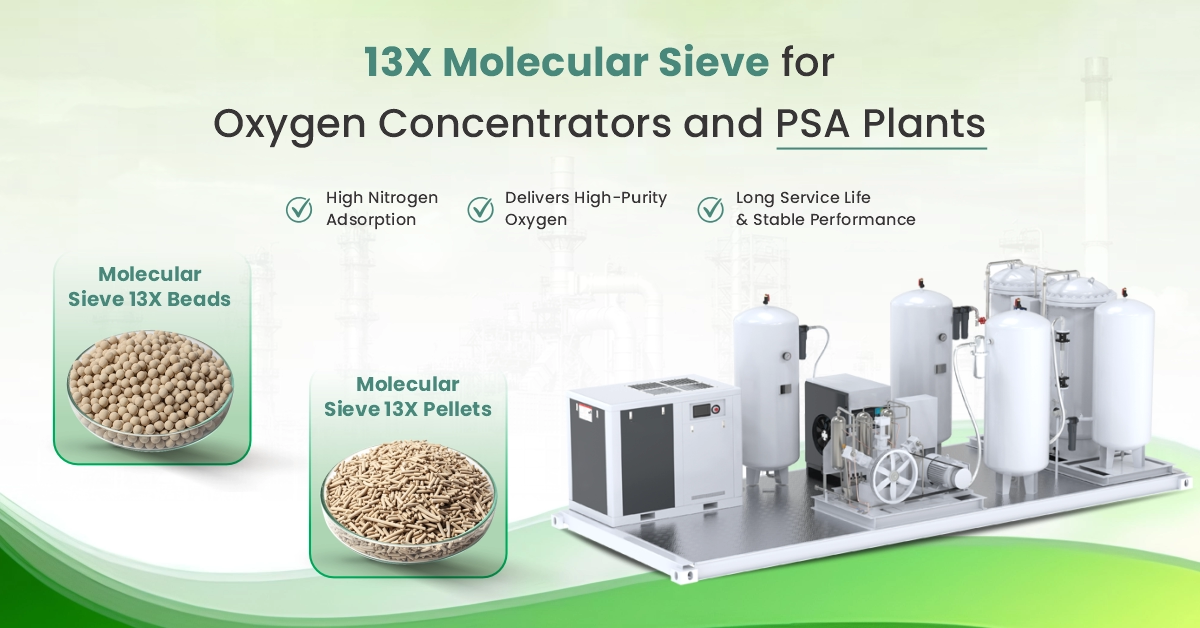
When a patient requires supplemental oxygen at home, or when a hospital needs a continuous, on-site supply of medical-grade oxygen, the technology making it possible is not a cylinder. It is a bed of adsorbent material specifically, a 13X molecular sieve oxygen concentrator system operating on the principle of Pressure Swing Adsorption. Understanding what 13X molecular sieve is, why it works for PSA oxygen generation, and how it performs across both medical and industrial applications is essential for anyone sourcing, specifying, or operating an oxygen plant adsorbent system.
What Is 13X Molecular Sieve?
Molecular sieves are synthetically manufactured zeolite materials with a highly ordered, three-dimensional porous structure. The framework is built from silicon dioxide (SiO2) and aluminium oxide (AlO4) tetrahedra, connected through shared oxygen atoms to form an interconnecting network of uniform pores and cavities. This structural regularity is not incidental — it is precisely what gives molecular sieves their unique capacity to discriminate between molecules on the basis of size and polarity.
The designation "13X" refers to the Type X crystal structure in sodium form, with a nominal pore diameter of 10 angstroms (1.0 nm). This pore size is significantly larger than that of 3A, 4A, or 5A variants, enabling the oxygen concentrator zeolite to selectively adsorb larger molecules — nitrogen, carbon dioxide, water vapour, argon, hydrogen sulphide, and ammonia — while allowing smaller, less polar oxygen molecules to pass through relatively unimpeded. It is this selectivity that makes 13X the adsorbent of choice for air separation and oxygen generation.
The PSA Process: How Oxygen Is Generated
PSA oxygen generation — Pressure Swing Adsorption — is the technology that transformed on-site oxygen production from a cryogenic industrial operation into something compact, continuous, and cost-effective enough for hospitals, clinics, and industrial facilities of almost any scale.
The process begins with ambient air, which is compressed and then pre-dried using an air dryer before entering the PSA adsorption vessels. Inside these vessels, the compressed air passes through beds of 13X molecular sieve. The sieve preferentially adsorbs nitrogen — the dominant component of air at approximately 78% — along with carbon dioxide, moisture, and trace impurities. Oxygen, which makes up roughly 21% of ambient air, passes through the bed relatively unobstructed and accumulates as the product stream.
The adsorption phase continues until the 13X sieve bed approaches saturation. At this point, the pressure in the vessel is rapidly reduced — this is the "swing" in Pressure Swing Adsorption. The sudden depressurisation causes the adsorbed nitrogen to desorb and vent to atmosphere, regenerating the sieve bed for the next adsorption cycle. In a typical PSA oxygen plant, two or more sieve beds operate in alternation — one adsorbing while the other regenerates — ensuring a continuous product oxygen flow.
The result is medical oxygen generation or industrial-grade oxygen with purity levels reaching 93–95%, delivered on-demand without cryogenic equipment, liquid oxygen storage tanks, or cylinder logistics.
Why 13X Is the Standard Adsorbent for Oxygen Generation
Several properties make 13X the benchmark oxygen plant adsorbent for PSA systems:
High nitrogen adsorption capacity. The 10-angstrom pore structure provides substantial surface area for nitrogen adsorption at operating pressures. Nitrogen molecules, with their strong quadrupole moment, interact favourably with the sodium cation sites in the 13X framework, enabling deep adsorption per unit volume of adsorbent.
Oxygen-nitrogen selectivity. In air separation adsorbent terms, what matters is not just how much nitrogen a material can hold, but how preferentially it holds nitrogen relative to oxygen. 13X in the sodium form delivers reliable O2/N2 selectivity under PSA operating conditions, making oxygen enrichment both efficient and consistent.
Simultaneous moisture removal. Incoming compressed air, even after pre-drying, retains trace moisture. 13X molecular sieve adsorbs water vapour with high affinity, effectively functioning as an oxygen concentrator drying agent simultaneously with its nitrogen-adsorption role. This dual action simplifies system design and protects downstream equipment.
CO2 removal. In applications where carbon dioxide removal from the air stream is critical — particularly in industrial oxygen purification and pre-cryogenic air treatment — 13X performs this function in the same adsorption step, eliminating the need for a separate scrubbing stage.
Regenerability. 13X can be fully regenerated either by pressure swing (as in standard PSA cycles) or by thermal regeneration at temperatures of 250–350°C followed by cooling. This regenerability is fundamental to the economics of a PSA oxygen plant — the adsorbent is not consumed; it is cycled, typically delivering many thousands of operational hours before performance degrades.
Forms and Configurations
13X molecular sieve is available in two primary physical forms for oxygen generation applications:
Beads (spherical, typically 1.6–2.5 mm or 3–5 mm diameter) offer low pressure drop across the adsorption bed, mechanical durability under repeated pressure cycling, and consistent packing density. Bead-form 13X is the standard choice for large-format PSA oxygen plants and industrial zeolite oxygen generators.
Pellets (extruded cylindrical form, typically 1.6 mm or 3.2 mm) offer slightly higher surface area per unit volume and are commonly used in smaller 13X molecular sieve oxygen concentrator units, including portable and homecare oxygen generators.
The choice between beads and pellets depends on vessel geometry, flow velocity, pressure drop tolerance, and system size. Both forms deliver equivalent adsorption chemistry the difference is purely mechanical and hydraulic.
Medical vs. Industrial Applications
In medical oxygen generation, 13X-based PSA systems serve hospitals, nursing homes, and homecare oxygen concentrator units. These systems must deliver oxygen at 93–95% purity consistently, with validated performance and compliance with pharmacopoeia standards. The reliability of the PSA oxygen molecular sieve bed is directly tied to patient safety. Adsorbent quality — in terms of surface area, crush strength, moisture loading, and pore uniformity — is therefore not a cost variable but a compliance requirement.
In industrial oxygen purification and industrial gas separation, 13X PSA systems serve steel manufacturing (for blast furnace enrichment), glass production, wastewater treatment (for aeration), aquaculture, paper and pulp bleaching, and chemical synthesis. Industrial systems typically operate at higher throughput and may accept slightly broader oxygen purity ranges, but the nitrogen adsorption zeolite performance requirements remain demanding.
In air separation adsorbent applications ahead of cryogenic plants — such as pre-purification units (PPUs) — 13X molecular sieve removes moisture, CO2, and hydrocarbons from the air stream before it enters cryogenic separation. This protects the cryogenic equipment from freezing and contamination, making 13X an upstream critical component even in plants that ultimately use cryogenic technology for final separation.
Selecting the Right 13X for Your Application
Not all 13X molecular sieves are equivalent. Key parameters to evaluate when specifying a zeolite oxygen generator adsorbent include:
Water adsorption capacity — typically measured as a percentage of sieve weight at defined relative humidity. Higher capacity means longer effective drying cycles.
Nitrogen adsorption capacity — measured in ml/g at defined pressure and temperature. This directly determines how much adsorbent volume is required for a given oxygen production rate.
Bulk density and crush strength — critical for bed stability under repeated pressurisation and depressurisation cycles. Low crush strength leads to fines generation, increased pressure drop, and eventual bed channelling.
Equilibrium moisture content on delivery — sieves that are incompletely activated or have absorbed atmospheric moisture in transit will underperform from the first cycle. Proper packaging and activation are non-negotiable.
For both logistics moisture control in transit and optimal performance on installation, 13X molecular sieve should be supplied in sealed, moisture-proof packaging and installed in adsorption vessels promptly after opening.
13X molecular sieve is not merely a component in an oxygen generation system — it is the mechanism by which oxygen is separated, dried, and delivered. Specifying the right grade, in the right form, for the right application is where reliable oxygen generation begins.
